


Descrizione del guerriero sannita



(Cliccare sul simbolo della lingua)
Guerriero sannita
https://www.dropbox.com/scl/fi/3ex757j0l3etsaary6lqm/ElevenLabs_2026-02-28T09_54_50_Luca-Brasi-Gentile_pvc_sp100_s50_sb75_se0_b_m2.mp3?rlkey=ukn207y49m4ohy8dpjfx4cg5a&st=xm4htbim&dl=1
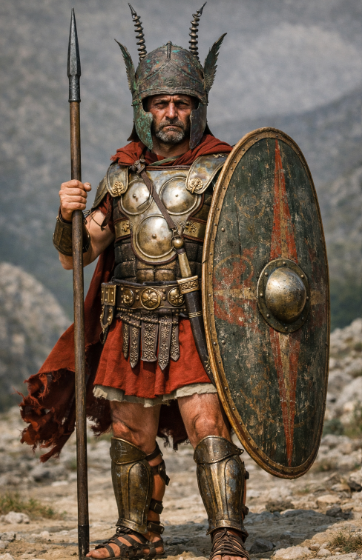
L’antico guerriero sannita si presentava come una figura possente e solenne, armata dalla testa ai piedi, pronta alla battaglia tra le montagne aspre del Sannio.
*
Sul capo indossava un elmo di bronzo dalla forma conica o arrotondata, spesso decorato con creste, piume alte o elementi laterali ricurvi, simboli di prestigio e valore. Le guance erano protette da paragnatidi metalliche che incorniciavano un volto duro, segnato dall’esperienza, con sguardo fermo e determinato.
*
Il busto era difeso da una corazza anatomica in bronzo oppure da una tipica armatura sannita a tre dischi (cardiophylax), costituita da piastre tonde fissate su supporto in cuoio, che proteggevano torace e addome. Sopra o sotto la corazza portava una tunica corta, generalmente di lana, stretta in vita da un cinturone corazzato riccamente decorato con placche metalliche incise, simbolo di rango e appartenenza tribale.
*
Al fianco pendeva una spada corta, adatta al combattimento ravvicinato, assicurata al cinturone con corregge in cuoio. Nella mano impugnava il giavellotto (pilum o hasta), arma da lancio micidiale prima dell’assalto corpo a corpo.
*
Il braccio sinistro sosteneva un lungo scudo ovale, robusto e leggermente convesso, realizzato in legno rivestito di cuoio e rinforzato da umbone centrale in metallo. Lo scudo era spesso decorato con motivi simbolici o colori tribali.
*
Le gambe erano protette da gambali in bronzo (schinieri), sagomati per aderire ai polpacci e difendere dalle ferite. Ai piedi calzava sandali di cuoio robusti, legati con corregge che salivano fino alla caviglia, adatti ai terreni montuosi e alle lunghe marce.
*
Nel suo insieme, l’abbigliamento del guerriero sannita univa funzionalità e fierezza: non solo protezione e potenza militare, ma anche espressione di identità, disciplina e orgoglio di un popolo montano, libero e combattivo.
Ancient Samnite warrior
Inglese
The ancient Samnite warrior appeared as a powerful and solemn figure, armed from head to toe, ready for battle among the rugged mountains of Samnium.
On his head he wore a bronze helmet, either conical or rounded in shape, often decorated with crests, tall plumes, or curved lateral elements—symbols of prestige and valor. His cheeks were protected by metal cheek guards that framed a stern face, marked by experience, with a steady and determined gaze.
His torso was defended by an anatomical bronze cuirass or by a typical Samnite three-disc armor (cardiophylax), consisting of round plates fixed onto a leather backing, protecting the chest and abdomen. Over or under the cuirass he wore a short tunic, generally made of wool, tightened at the waist by an armored belt richly decorated with engraved metal plates, symbolizing rank and tribal affiliation.
At his side hung a short sword, suited for close combat, secured to the belt with leather straps. In his hand he held a javelin (pilum or hasta), a deadly throwing weapon used before engaging in hand-to-hand combat.
His left arm supported a long oval shield, sturdy and slightly convex, made of wood covered with leather and reinforced with a central metal boss. The shield was often decorated with symbolic motifs or tribal colors.
His legs were protected by bronze greaves, shaped to adhere closely to the calves and guard against wounds. On his feet he wore sturdy leather sandals, fastened with straps rising to the ankle, suitable for mountainous terrain and long marches.
Overall, the Samnite warrior’s attire combined functionality and pride: not only protection and military strength, but also an expression of identity, discipline, and the pride of a free and warlike mountain people.
Antike samnitische Krieger
TEDESCO
Der antike samnitische Krieger erschien als eine mächtige und würdevolle Gestalt, von Kopf bis Fuß bewaffnet, bereit zum Kampf in den rauen Bergen Samniums.
Auf dem Kopf trug er einen Bronzehelm in konischer oder abgerundeter Form, oft verziert mit Kämmen, hohen Federn oder geschwungenen seitlichen Elementen – Symbole von Prestige und Tapferkeit. Seine Wangen wurden von metallenen Wangenklappen geschützt, die ein hartes, von Erfahrung geprägtes Gesicht mit festem und entschlossenem Blick einrahmten.
Sein Oberkörper wurde entweder durch einen anatomisch geformten Brustpanzer aus Bronze oder durch eine typische samnitische Dreischeibenrüstung (Cardiophylax) geschützt, die aus runden Platten bestand, die auf einer Lederunterlage befestigt waren und Brust sowie Bauch schützten.
Über oder unter dem Harnisch trug er eine kurze, meist aus Wolle gefertigte Tunika, die in der Taille von einem reich verzierten, gepanzerten Gürtel mit eingravierten Metallplatten gehalten wurde – ein Zeichen von Rang und stammesmäßiger Zugehörigkeit.
An seiner Seite hing ein Kurzschwert, geeignet für den Nahkampf, das mit Lederriemen am Gürtel befestigt war. In der Hand hielt er einen Wurfspeer (Pilum oder Hasta), eine tödliche Waffe, die vor dem direkten Nahkampf eingesetzt wurde.
Sein linker Arm trug einen langen, robusten und leicht gewölbten ovalen Schild, aus Holz gefertigt, mit Leder überzogen und durch einen zentralen Metallbuckel verstärkt. Der Schild war häufig mit symbolischen Motiven oder Stammesfarben verziert.
Seine Beine wurden von bronzenen Beinschienen (Schienbeinen) geschützt, die sich eng an die Waden anschmiegten und vor Verletzungen bewahrten. An den Füßen trug er robuste Ledersandalen, die mit Riemen bis zum Knöchel geschnürt waren, geeignet für bergiges Gelände und lange Märsche.
Insgesamt vereinte die Ausrüstung des samnitischen Kriegers Funktionalität und Stolz: nicht nur militärischen Schutz und Stärke, sondern auch den Ausdruck von Identität, Disziplin und dem Stolz eines freien und kämpferischen Bergvolkes.
(Cliccare sul simbolo della lingua)
Guerriero sannita
https://www.dropbox.com/scl/fi/3ex757j0l3etsaary6lqm/ElevenLabs_2026-02-28T09_54_50_Luca-Brasi-Gentile_pvc_sp100_s50_sb75_se0_b_m2.mp3?rlkey=ukn207y49m4ohy8dpjfx4cg5a&st=xm4htbim&dl=1
L’antico guerriero sannita si presentava come una figura possente e solenne, armata dalla testa ai piedi, pronta alla battaglia tra le montagne aspre del Sannio.
*
Sul capo indossava un elmo di bronzo dalla forma conica o arrotondata, spesso decorato con creste, piume alte o elementi laterali ricurvi, simboli di prestigio e valore. Le guance erano protette da paragnatidi metalliche che incorniciavano un volto duro, segnato dall’esperienza, con sguardo fermo e determinato.
*
Il busto era difeso da una corazza anatomica in bronzo oppure da una tipica armatura sannita a tre dischi (cardiophylax), costituita da piastre tonde fissate su supporto in cuoio, che proteggevano torace e addome. Sopra o sotto la corazza portava una tunica corta, generalmente di lana, stretta in vita da un cinturone corazzato riccamente decorato con placche metalliche incise, simbolo di rango e appartenenza tribale.
*
Al fianco pendeva una spada corta, adatta al combattimento ravvicinato, assicurata al cinturone con corregge in cuoio. Nella mano impugnava il giavellotto (pilum o hasta), arma da lancio micidiale prima dell’assalto corpo a corpo.
*
Il braccio sinistro sosteneva un lungo scudo ovale, robusto e leggermente convesso, realizzato in legno rivestito di cuoio e rinforzato da umbone centrale in metallo. Lo scudo era spesso decorato con motivi simbolici o colori tribali.
*
Le gambe erano protette da gambali in bronzo (schinieri), sagomati per aderire ai polpacci e difendere dalle ferite. Ai piedi calzava sandali di cuoio robusti, legati con corregge che salivano fino alla caviglia, adatti ai terreni montuosi e alle lunghe marce.
*
Nel suo insieme, l’abbigliamento del guerriero sannita univa funzionalità e fierezza: non solo protezione e potenza militare, ma anche espressione di identità, disciplina e orgoglio di un popolo montano, libero e combattivo.
Ancient Samnite warrior
Inglese
The ancient Samnite warrior appeared as a powerful and solemn figure, armed from head to toe, ready for battle among the rugged mountains of Samnium.
On his head he wore a bronze helmet, either conical or rounded in shape, often decorated with crests, tall plumes, or curved lateral elements—symbols of prestige and valor. His cheeks were protected by metal cheek guards that framed a stern face, marked by experience, with a steady and determined gaze.
His torso was defended by an anatomical bronze cuirass or by a typical Samnite three-disc armor (cardiophylax), consisting of round plates fixed onto a leather backing, protecting the chest and abdomen. Over or under the cuirass he wore a short tunic, generally made of wool, tightened at the waist by an armored belt richly decorated with engraved metal plates, symbolizing rank and tribal affiliation.
At his side hung a short sword, suited for close combat, secured to the belt with leather straps. In his hand he held a javelin (pilum or hasta), a deadly throwing weapon used before engaging in hand-to-hand combat.
His left arm supported a long oval shield, sturdy and slightly convex, made of wood covered with leather and reinforced with a central metal boss. The shield was often decorated with symbolic motifs or tribal colors.
His legs were protected by bronze greaves, shaped to adhere closely to the calves and guard against wounds. On his feet he wore sturdy leather sandals, fastened with straps rising to the ankle, suitable for mountainous terrain and long marches.
Overall, the Samnite warrior’s attire combined functionality and pride: not only protection and military strength, but also an expression of identity, discipline, and the pride of a free and warlike mountain people.
Antike samnitische Krieger
TEDESCO
Der antike samnitische Krieger erschien als eine mächtige und würdevolle Gestalt, von Kopf bis Fuß bewaffnet, bereit zum Kampf in den rauen Bergen Samniums.
Auf dem Kopf trug er einen Bronzehelm in konischer oder abgerundeter Form, oft verziert mit Kämmen, hohen Federn oder geschwungenen seitlichen Elementen – Symbole von Prestige und Tapferkeit. Seine Wangen wurden von metallenen Wangenklappen geschützt, die ein hartes, von Erfahrung geprägtes Gesicht mit festem und entschlossenem Blick einrahmten.
Sein Oberkörper wurde entweder durch einen anatomisch geformten Brustpanzer aus Bronze oder durch eine typische samnitische Dreischeibenrüstung (Cardiophylax) geschützt, die aus runden Platten bestand, die auf einer Lederunterlage befestigt waren und Brust sowie Bauch schützten.
Über oder unter dem Harnisch trug er eine kurze, meist aus Wolle gefertigte Tunika, die in der Taille von einem reich verzierten, gepanzerten Gürtel mit eingravierten Metallplatten gehalten wurde – ein Zeichen von Rang und stammesmäßiger Zugehörigkeit.
An seiner Seite hing ein Kurzschwert, geeignet für den Nahkampf, das mit Lederriemen am Gürtel befestigt war. In der Hand hielt er einen Wurfspeer (Pilum oder Hasta), eine tödliche Waffe, die vor dem direkten Nahkampf eingesetzt wurde.
Sein linker Arm trug einen langen, robusten und leicht gewölbten ovalen Schild, aus Holz gefertigt, mit Leder überzogen und durch einen zentralen Metallbuckel verstärkt. Der Schild war häufig mit symbolischen Motiven oder Stammesfarben verziert.
Seine Beine wurden von bronzenen Beinschienen (Schienbeinen) geschützt, die sich eng an die Waden anschmiegten und vor Verletzungen bewahrten. An den Füßen trug er robuste Ledersandalen, die mit Riemen bis zum Knöchel geschnürt waren, geeignet für bergiges Gelände und lange Märsche.
Insgesamt vereinte die Ausrüstung des samnitischen Kriegers Funktionalität und Stolz: nicht nur militärischen Schutz und Stärke, sondern auch den Ausdruck von Identität, Disziplin und dem Stolz eines freien und kämpferischen Bergvolkes.